
The Weirdest Sports Memorabilia Ever Sold, From Autographed Urinals to Ty Cobb’s Dentures | The Lockdown Millionaire
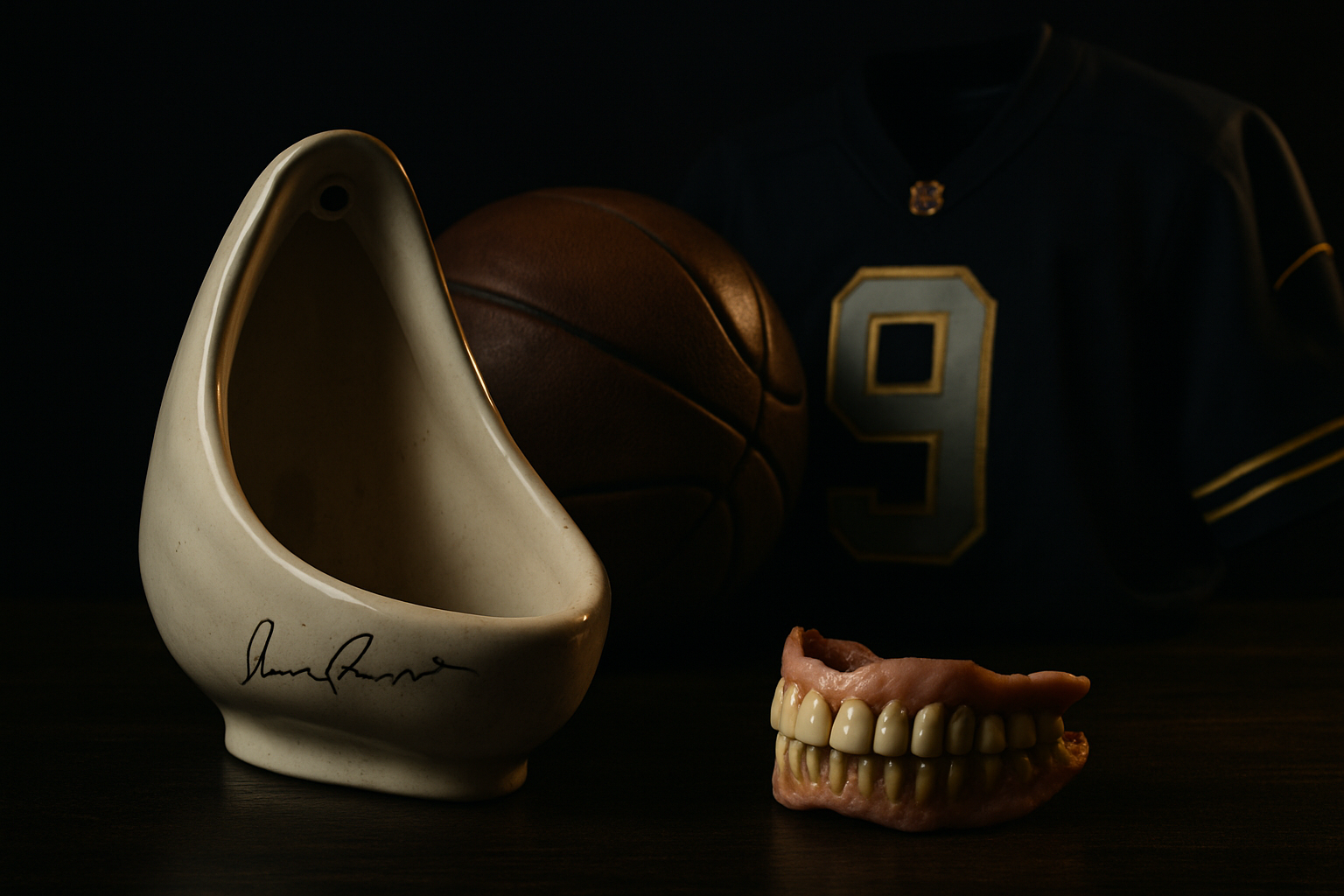
Sports memorabilia usually brings to mind the classics: game-worn jerseys, signed baseballs, ticket stubs, championship rings, and the occasional card so rare it needs its own insurance policy. But the collecting world has always had a gloriously weird side. Once fandom, scarcity, and a good story collide, almost anything can become valuable — even if that “anything” once lived in a locker room bathroom or someone’s mouth.
The truth is, collectors are not just buying objects. They are buying proximity to greatness, a conversation piece, and often a slice of sports mythology. That is how the hobby ends up producing some of the strangest sales imaginable: autographed urinals, fight-worn jockstraps, used dentures, chewed gum, and even stale dessert. Ridiculous? Absolutely. But also very real — and very revealing about how emotional and eccentric the memorabilia market can be.
When a Stadium Urinal Becomes a $3,000 Collectible
One of the most bizarre examples came from the old Pontiac Silverdome. A Detroit Lions fan acquired a discarded locker room urinal from the stadium, got Hall of Famer Barry Sanders to autograph it, and then resold it on eBay for $3,000.
On paper, that sounds absurd. In practice, it checks every box collectors love: a connection to a historic venue, a link to a beloved franchise icon, and a level of novelty that makes it unforgettable. Plenty of signed footballs exist. A signed Silverdome urinal tied to Barry Sanders? There is only so much competition for that.
That is one of the hidden rules of oddball memorabilia: uniqueness can outweigh elegance. If an item is strange enough, authentic enough, and backed by a famous name, it stops being junk and starts becoming lore.
The Extremely Personal Side of Sports Collecting
Memorabilia can also get uncomfortably intimate. Boxing legend Joe Frazier’s actual athletic supporter from his 1971 victory over Muhammad Ali sold at auction for $10,200. As if that were not enough to prove there is a market for absolutely everything, a collector reportedly paid $25,000 for a jockstrap allegedly worn by baseball pitcher Nolan Ryan.
These are not items most people would dream of displaying in a den or office. Yet they carry an undeniable closeness to the athlete and moment in question. A glove or robe is one thing. A jockstrap is another level entirely — raw, personal, and impossible to separate from the body of the competitor who wore it.
That may be exactly why some collectors want it. In a hobby driven by authenticity, few things feel more undeniably “real” than an item that was quite literally worn in battle.
Ty Cobb’s Dentures: A Piece of History With Bite
Baseball has always inspired some of the strangest collecting behavior, and Ty Cobb’s dentures are a perfect example. The Hall of Famer’s used false teeth sold for $7,475 in 1999. Even more wonderfully, the buyer — a dentist’s daughter — described them as “a piece of history” and later loaned them to the Baseball Hall of Fame for display.
That detail is what makes this story more than just a punchline. Once an unusual item is linked to a legendary figure and treated as a historical artifact, it can cross over from novelty into legitimate cultural memorabilia. Dentures may seem laughable at first glance, but Cobb’s dentures are not just dentures. They are a tangible personal relic from one of baseball’s most famous and infamous stars.
That shift in context is everything in collectibles. The object itself may be ordinary or even grotesque. The story attached to it is what creates value.
Chewed Gum, Snack Cakes, and Other Sports Oddities
If you think the weirdness stops with plumbing fixtures and dental appliances, it does not. Some of the most head-scratching sales involve disposable items that should never have survived in the first place.
- Luis Gonzalez’s chewed bubblegum fetched $10,000 for charity.
- A Twinkie autographed by pitcher David Price sold on eBay for $56.
- A 53-year-old slice of wedding cake from Joe DiMaggio’s first marriage sold for $715.
- A baseball signed by Pete Rose with the bizarre inscription “I’m sorry I shot JFK” sold for $107.
These items work because they are strange in different ways. The gum is gross but uniquely personal. The Twinkie is funny because it is so disposable. The wedding cake taps into celebrity nostalgia. And the Pete Rose ball shows how collectors will pay for humor, controversy, and oddball inscriptions just as readily as they will pay for a clean autograph.
In other words, not every collectible has to be dignified. Sometimes the appeal is that it is completely ridiculous.
Why Do People Buy This Stuff?
At first glance, these sales seem like proof that collectors will buy literally anything. But there is a pattern to all of them. The weirdest memorabilia tends to succeed when it combines a few specific ingredients:
- Celebrity connection: The item must tie directly to a famous athlete or sports personality.
- Story value: The weirder the backstory, the more memorable the piece becomes.
- Scarcity: There may be thousands of signed photos, but only one signed locker room urinal from a demolished stadium.
- Conversation power: Some collectors want an item that instantly dominates the room.
- Emotional fandom: Sports fans do not always buy with logic. They buy with affection, nostalgia, and obsession.
This is what makes sports memorabilia such a fascinating market. Value is not always about beauty or utility. It is often about meaning. A chewed piece of gum can outshine a polished display piece if the story is good enough.
The Line Between Trash and Treasure
Sports collecting has always rewarded the unusual, but these sales push that idea to its limit. They also highlight a basic truth about collectibles in general: the market decides what matters, not common sense. A bathroom fixture, a used dental appliance, or a decades-old snack should be worthless by ordinary standards. In the right context, each becomes a tiny monument to fandom.
That may sound irrational, but it is also part of the fun. Memorabilia is not merely about preserving objects. It is about preserving emotions, moments, legends, and the strange ways fans try to get closer to the athletes they admire. Sometimes that means a signed jersey. Sometimes it means a piece of chewed gum in a display case.
Anything Goes in the Memorabilia Game
From Barry Sanders’ autographed urinal to Ty Cobb’s dentures, the strangest corners of the sports memorabilia world prove that there is no strict rulebook for what becomes collectible. If an item has a famous name, a memorable story, and enough shock value to make people laugh, cringe, or stare, someone will likely want it.
And that is really the beauty of the hobby. One fan sees trash. Another sees history. In sports collecting, almost anything connected to a big personality or unforgettable moment can become a treasure — no matter how weird, hilarious, or wildly inappropriate it may seem.